
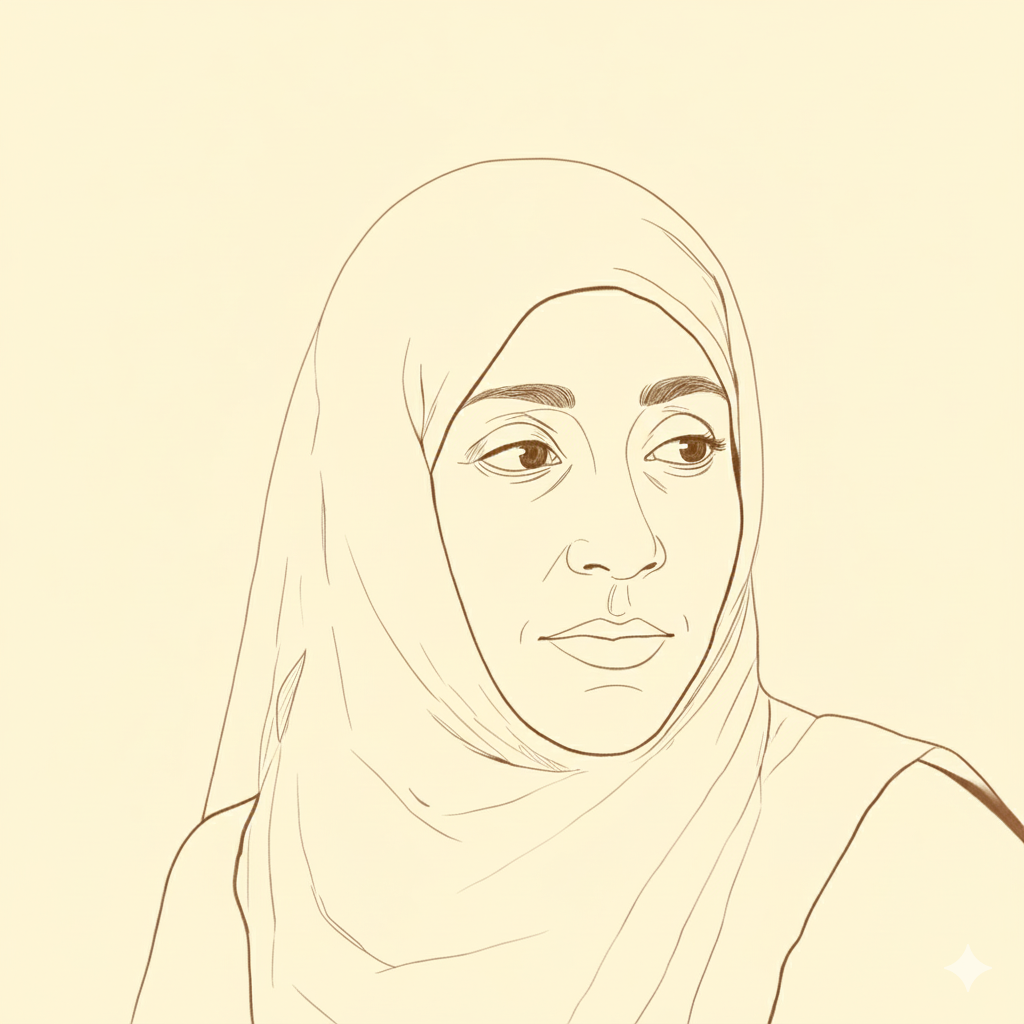
This is but a fragment of Al-Gharbi Amran. Before delving deeper into his literary world, we pause briefly at some stages of his life, shaping them into a short, evocative story… listen.
In Sana’a — that city which, when it awakens each morning, seems to recreate the world as if it were being born for the first time — women’s voices sing before the birds do; men prepare for their day with the words “Ya Allah, grant Your pleasure,” followed by a warm bite of food that steels their resolve. The breeze carries the scent of bar‘ee bread mingled with zalabiya, the clamor of markets rises, the aroma of small eateries lingers, women’s robes flow in black and red, and children’s hands cling tightly to their parents, wary of the crowds.
Within such an atmosphere, the lovers of this city are born.
In 1958, when buildings were few and made of mud and plaster, schools scattered like a beauty mark on a fair cheek, and healthcare facilities were scarce, that child was born in a neighborhood... and his name was (Mohammed).
He took from Sana’a its beautiful spirit that embraces everyone, its compassionate heart that turns no one away, and some of its features which it bestows upon those who love it.
He began writing his first letters in another country (Sudan), but he stayed no more than two years before returning to Yemen to carve his name into its rocks—a name that would later be immortalized in literature. He completed part of his studies there, then moved to another country (Saudi Arabia), where he studied and worked. He then returned to complete his academic studies in history in Sana’a, and later spent several stages of his life in Egypt. How could the Mother of the World not be a mother to Al-Gharbi? Mohammed completed his history studies, which he loved so dearly that he wrote a new historical account from his imagination, blending two realities—the recorded reality and the reality that perhaps existed but was never written. He opened a wide literary door for himself, even weaving a majestic palace from his imagination, constructed upon delicate threads of that historical residue.
Regarding another aspect of his life, his professional career: he was elected as the head of the local council in his district of 'Ans, Dhamar Governorate, and later as a member of the House of Representatives. He was appointed advisor to the Capital Secretariat in 2010, and later Deputy Secretary in 2015. It seems that his professional work and his literary pursuits, both residing in the Arabic language, never fully met, and one overshadowed the other.
Al-Gharbi and Literature:
That child grew into a man who writes, having absorbed numerous books and matured through them. Books became the other world in which Al-Gharbi was reborn in a new form. He left an indelible mark on his writings, and his novels are among the most successful historical novels in Yemen. Al-Gharbi’s literary journey began with short stories, and he published several short story collections:
- "Al-Sharashif" (Story), Damascus: Arab Writers Union, 1997.
- "The Naked Shadow" (Story), Sana’a: General Authority for Books, 1998.
- "Hareem A’zzakum Allah" (Story), Cairo: Center for Arab Civilization, 2001.
- "Khitān Balqīs" (Story), Sana’a: Story Club, 2002.
- "A Black Lighthouse" (Story), Sana’a: Union of Yemeni Writers and Authors, 2004.
The Literary Birth of Al-Gharbi:
The red lines began with a red Quran and have never ended...
The author’s reliance on imagination is the driving force behind his writings; it is the tool Al-Gharbi used in crafting his "fantasy" novels. And what kind of fantasy? Historical fantasy. Al-Gharbi believes that a novelist does not seek historical truth to write a novel but longs for artistic truth, whereas a historian seeks truth if detached from personal biases and affiliations.
Al-Gharbi always asserts his view that he does not write historical novels constrained strictly by the recorded events documented by the victors. Instead, he explores between the lines and behind the facts, inventing peasant and military characters who narrate their destinies, without making the authoritarian figure central. For him, history is a tool to soar with imagination, bringing forth characters and events that exist only in the novel. This is exemplified in "Red Quran" and the works that followed.
Moshah Ahmer ("The Red Quran") Up Close:
The novel "Moshah Ahmer" was published in 2010, and what distinguished this novel and shaped Amran the Writer is its immersion in the triad that is forbidden, desirable, and provocative all at once.
What the novel proclaims through layers of narrative, symbolism, and imagination is one thing: a call for tolerance, emphasizing that religion is one because God is one. The revealed holy books are a call to this truth—so why the conflict?
From a political perspective, the symbolism embraces characters and certain events, while history is presented with its factual numbers to indicate the real impact that produced this rebellious literary event. Just as Amran began by portraying women with garments of strength and actual societal influence, he continued his literary journey with the same emphasis on women, forming a coherent chain of strong bonds.
Characters in the novel: (Taba’a, Shakhnama, Al-Atwi, Sambriah...)
This leads us to the names of Amran’s protagonists and the sources of these names. He says: "I strive in selecting the names of my characters to fit the era and the composition of the personality. Therefore, the reader may find the names in my novel unusual, but soon accepts and becomes familiar with them as they navigate the worlds of the novel. Most readers seek the meanings and implications of these names and may discover interpretations I did not intend, yet they add additional dimensions for the reader." The ending of the novel opens the door to other literary worlds of Amran.