
An Interview with the Yemeni Lawyer Maeen al Abidi.
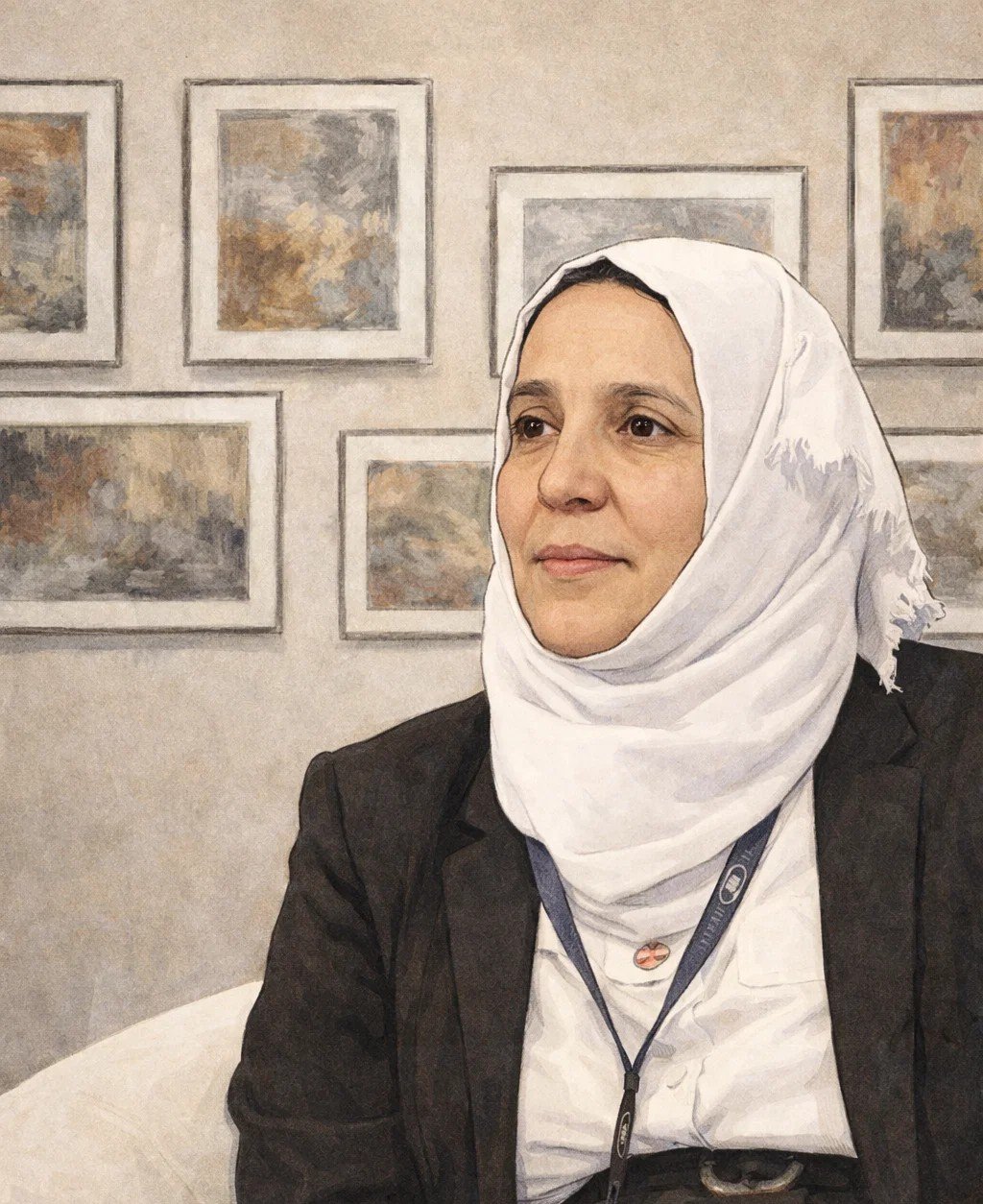
In the heart of the city of Taiz—where souls mingle with the scent of gunpowder and the hymns of hope—Maeen Al-Obaidi emerges as a luminous star in a darkened sky. She is not merely a lawyer or a human-rights activist; she is a fervent spirit who has devoted herself to defending the rights of the marginalized and to building bridges of peace in times of war. Maeen began her professional journey more than two decades ago, at a time when women in her community were searching for a voice to defend their rights in courtrooms and behind the walls of their homes. With unyielding determination, she confronted the challenges of a conservative society, carrying the heavy burden of complex cases upon her shoulders. With a spirit unafraid of confrontation, she fought relentlessly for justice and equity.
With the onset of the darkness of war, Maeen realized that her true battle was no longer confined to court halls alone, but extended to the streets and public squares—among people consumed by the flames of conflict. She chose to become a bridge between rival parties, carrying the torch of peace amid the blaze of violence.
In Taiz, a city scarred by the ravages of war, she worked tirelessly, surrounding women who had lost hope and supporting them as they confronted the harsh realities of life.
She contributed to providing legal and social assistance and built bridges of trust among the community in all its components, striving to alleviate their suffering and open new horizons toward peace.
Moeen was distinguished by her positive relationships with all conflicting parties, which enabled her to mediate the reopening of roads, facilitate prisoner exchanges, and help restore essential services that had been disrupted as a result of the war.
Despite the difficulties and challenges—particularly as a woman in a male-dominated society.
Her determination was never broken; rather, she continued her struggle, firmly believing that justice and peace are inseparable, and that both constitute a fundamental pillar for building a cohesive and resilient society.
Moeen Al-Abidi embodies a living example of courage and dedication. Today, she is regarded as a symbol of the struggle for human rights and peacebuilding in Yemen. Her story is not merely a success narrative; it is an epic woven from willpower and faith in the power of the word and the supremacy of justice amid war and conflict.
In the Jordanian capital, Amman, we met with Moeen and were pleased to receive her thoughtful responses to our questions.
Who is Maeen al-Abidi?
Moeen, a lawyer and a human rights and community activist, was born in Taiz, where she grew up among its mountains and valleys. She began her journey more than twenty years ago advocating for women and volunteering to address their legal and social issues. Since the outbreak of the war, she has worked on peacebuilding initiatives and on mitigating the problems resulting from conflict. It was our duty, as members of Yemeni society, to stand by and support affected civilians, particularly women.
What motivated you to choose peace and work toward promoting it, rather than pursuing the legal profession alone??I did not choose peace as an alternative to law; law is my primary profession, one that I love deeply and take great pride in. I am honored to be a human-rights lawyer and among the first generation of women rights defenders in Yemen. As women working in a challenging environment, we consciously chose this path and have long strived to end the war and promote peace—not as a substitute for legal practice, but as a natural extension of my mission as a lawyer. Peace is the other face of justice, and justice is the root of peace. I came to realize that striving for peace is a longer and more arduous path, yet one that carries within it the hopes of future generations. Since war is transient, no matter how long it lasts, we must be precise in our language and call this a struggle for peace rather than merely a profession. Peace is a humanitarian imperative, not an occupation one can simply practice. Before it manifests on the ground, peace is also an inner state; God is Peace, and we are born of its spirit. Peace and tranquility precede war and destruction. I live in the city of Taiz, one of the places most devastated by the war—its land and people, its trees and birds, everything here has suffered. We have endured profound harm, widespread displacement, and fearful flight. I felt it was my duty to remain in Taiz to support women who had no shelter. We sought to de-escalate tensions and bridge differences, having witnessed the suffering firsthand since the very outbreak of the conflict. Prior to the war, we maintained relations of mutual understanding with all parties; this proved positive for me and greatly facilitated my work.
How did she engage with the community as a human-rights activist of notable influence in Taiz?I have remained in Taiz since graduating from its university, staying true to this city that I have always loved. I have worked in the field of human rights, standing alongside its women, the poor, the marginalized, and female prisoners. All of this placed a significant responsibility on me within the community, especially as I defended imprisoned women who were often regarded as lesser. Recently, the community has come to accept me as an activist opposing the war, and I have served as a mediator to alleviate its suffering—opening roads, facilitating prisoner exchanges, and working to provide basic public services that were entirely disrupted due to the conflict, keeping them neutral from the strife. The community believes in you when it sees that you work for it, accepting you wholeheartedly and becoming your primary support.
How do you navigate the challenges you face as a lawyer and activist in the context of war?Let us differentiate between my roles as a lawyer and as an activist. From the beginning of the war until its midpoint, the courts had ceased functioning. We faced significant challenges as lawyers, particularly as women. One of the primary obstacles was the community’s reluctance to accept a woman working for peace and the cessation of the war. Thanks to my acquaintance with numerous influential figures across all parties, this was the sole factor that earned their trust or allowed them to accept the idea of a woman working for peace. Many situations arose, especially when my work required me to meet religiously conservative leaders, who often reacted upon seeing that I, Mueen Al-Obaidi, was a woman rather than a man. Everyone has their opinions and perspectives, and I never let this bother me, as I am firmly committed to the work I undertake.
What advice would you offer to women who are striving for peace in their countries?My advice to both women and men, to anyone who wishes to be an agent for peace, is to believe in what you do and to be sincere. Do not act for appearances—like someone building a paper house in a time of wind and fire—but be truly committed to your actions. Do not fear what others may say about you, and be a promoter of peace wherever you can: in your country, and if that is not possible, in your city or village, and if not there, in your own home—this is the least one can do.
How can local communities contribute to peacebuilding?Local communities are the foundation of any constructive process. Through awareness, education, and collaboration, peace can be achieved. Participation in community dialogue, fostering trust among individuals, and supporting humanitarian initiatives are essential steps toward peace. Communities should, as much as possible, avoid slipping into conflict; this simple measure can significantly mitigate its effects. Guiding children toward educational centers and standing by them is crucial, for if the young are not nurtured as seeds of peace, they become the fuel of war. Attention should also be given to self-development using the resources at hand, as is currently happening in some Yemeni villages, where community contributions play a significant role in repairing roads and supporting those affected to the greatest extent possible.
What do you believe needs to change in order to achieve lasting peace in Yemen?What we need is to promote a culture of peace. The stability of the country is our responsibility, and there can be no stability unless we ourselves believe in it and work toward it. It is incumbent upon us to move in that direction.
What had the greatest impact on your life and led you to become a human-rights activist committed to promoting peace?There were many accumulations, events layered upon one another. After graduating from high school, I made the decision to study law. That study illuminated my perspective with a new light, allowing me to see the world through the lens of victims and the oppressed. Knowing your rights yet being completely deprived of them is an experience of profound bitterness. I began volunteering alongside women and witnessed firsthand many of them in prisons—innocent women whose only “crime” was poverty and marginalization, unable to afford the legal representation needed to defend them in court. These innocent women were imprisoned for three years or more, with their cases left idle in prosecutorial drawers, despite the fact that their cases should have been resolved within a month or two at most. Seeing these women endure such suffering gave me a powerful impetus to continue my struggle and made me realize the importance of working for justice and rights, no matter how difficult the circumstances.
How can young people be part of the peace movement?
First and foremost, as I mentioned earlier, young people must avoid being engulfed in the flames of war. They are a generation born and raised amidst the conflict, and it is essential that they do not become part of this tragedy, but instead turn towards education and knowledge. Youth are a vibrant force, capable of shaping the destiny of the nation. If young people do not rise, it will be difficult for peace to prevail across this homeland. Who else will carry the banner of hope and stand against injustice? My hope rests on these young men and women, for they are the foundation upon which the future is built.
And no matter how long this nation’s winter lasts, spring will inevitably come, and we hold tightly to the bonds of hope, praying that it arrives swiftly.