
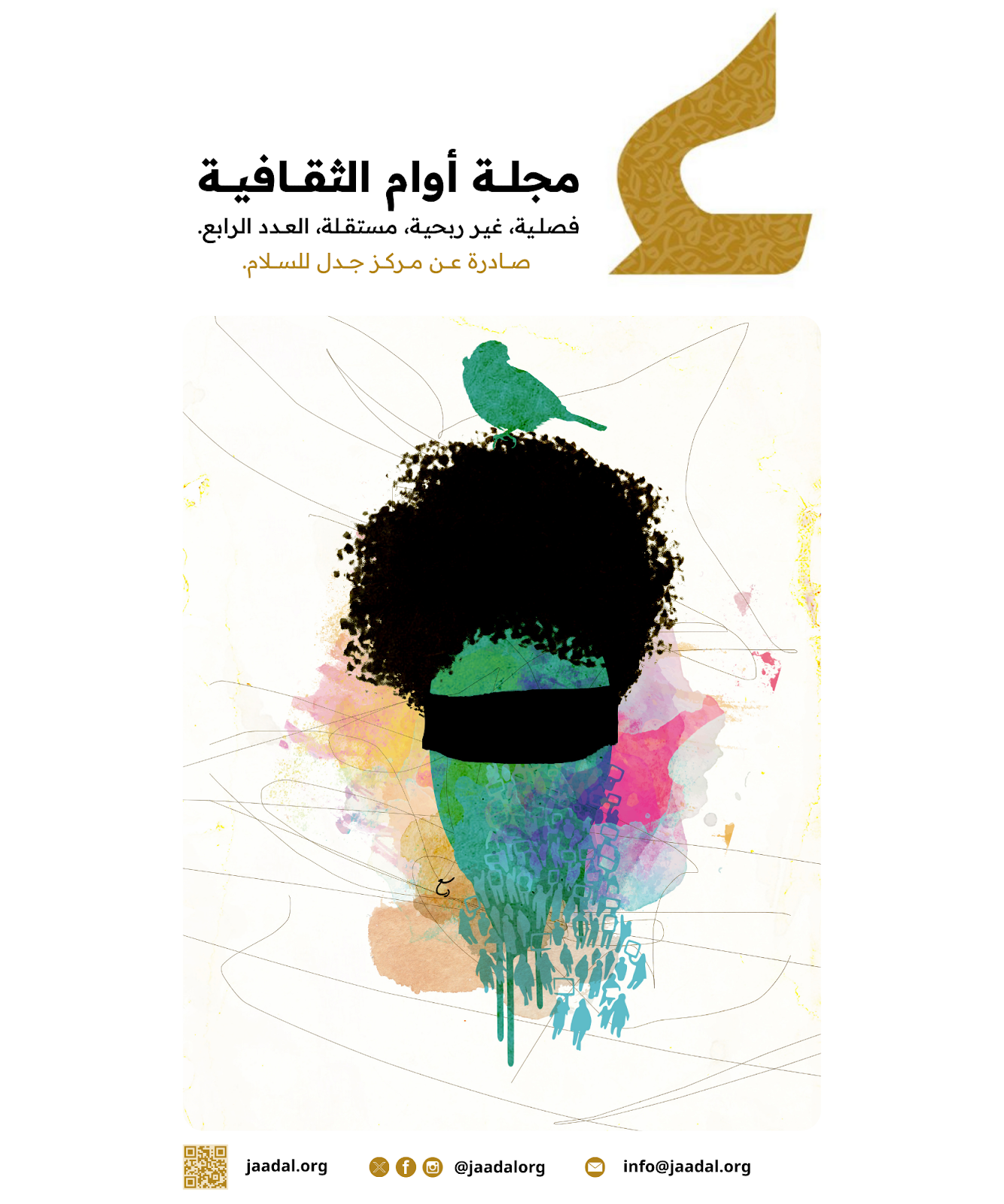
The fourth issue of Awam Cultural Magazine features a body of knowledge distributed across diverse analytical, literary, and philosophical sections. It opens with the editorial written by Editor-in-Chief Bashar al Aqab, titled “Don’t Bother Anyone”, a phrase inspired by the late Mufti Mohammed bin Ismail Al-Umrani. In this editorial, Al-Oqab explores the psychology of cautious coexistence in the city of Sana’a, arguing that peace within the context of war becomes a practical survival skill based on restraint, minimizing friction, and avoiding drawing attention in order to sustain daily life with the least possible harm.
In the opinion articles section, Managing Editor Abduh Taj presents a historical and political reading entitled “Carry Out God’s Will, O Shawl”, in which he examines the life of Ahmad bin Yahya Hamid al-Din and the ways religious discourse was employed in political conflicts and the elimination of opponents. He notes that religion functioned as a central reference that Ahmad Hamid al-Din strategically invested in to reinforce the legitimacy of his rule.
Dr. Abdullah al Aqab puts forward a vision asserting that the economy represents the shortest path to peace in Yemen, as elaborated in “The Economy Is the Shortest Path to Peace in Yemen”. He emphasizes that the collapse of institutions and the spread of unemployment have rendered young people easy targets for recruitment, and that revitalizing production and supporting small-scale projects are the most effective means of dismantling the “war economy.”
In a related context, Dr. Al-Zahraa Al-Araiqi examines the prospects of community peace, calling for the creation of a “hybrid justice” that integrates Yemeni tribal customs with human rights principles, given the proven effectiveness of these customs in resolving complex disputes, reopening roads, and facilitating prisoner exchanges throughout years of conflict.
Saber Al-Jaradi contributes an article on the role of ancient Yemeni tales as an oral archive of social peace, arguing that these stories teach successive generations how to differ without annihilation, favoring attainable settlements over the silence imposed by decisive endings. On the philosophical front, Khaled Al-Yamani discusses “Contradiction as a Fundamental Dimension” among thinkers, asserting that changing opinions is a sign of maturity and accumulated knowledge rather than a flaw. Abdul Fattah Ismail Al-Khader also explores the philosophy of the “Übermensch” in Thus Spoke Zarathustra as conveyed by Nietzsche, clarifying the concepts of reason and virtue within this complex philosophical framework.
In literary criticism, Professor Dr. Ahmed Al-Surri presents a detailed critical reading of the Booker Prize–winning novel “Prayer of Anxiety”, analyzing its use of fantasy and symbolism—such as the “Statue of Abdel Nasser” and the “Turtle Heads”—to interrogate political reality and dismantle the totalitarian structure of regimes.
The issue also addresses contemporary political developments through an analysis by the Jadal for Peace Center on the situation in Hadramout, examining the dimensions of the conflict, balances of power in eastern Yemen, and their impact on the security of maritime corridors and oil facilities.
The issue concludes with creative and narrative texts reflecting human and existential anxiety, including “The Tenth Commandment” by Dhikrayat Aqlan, which explores the fears of a child in a troubled family environment; “Rasmiyah” by Shams Jiblah, depicting a human tragedy linked to physical and social marginalization; and “An Abandoned Window” by Laila Hussein Ali, overflowing with feelings of sorrow and alienation.
All these pages and sections are visually enriched with expressive artworks by artist Saad Al-Shehabi, Visual Content Editor, completing the visual and intellectual identity of this issue.
The fourth issue of Awam Magazine presents a set of profound conclusions that go beyond a superficial reading of the Yemeni crisis. It argues that peace in the current Yemeni context is not necessarily built solely through major political agreements, but is fundamentally rooted in a conscious collective decision to refrain from harm and allow space for others—a concept described as a daily survival skill embodied in the phrase “Don’t Bother Anyone.” Reducing friction and avoiding provocation thus emerge as the most effective tools for preserving social cohesion in the absence of the state.
The magazine further emphasizes that economic stability is the true locomotive of politics, and that restoring institutions while supporting small and productive enterprises constitutes the shortest path to dismantling the war economy that feeds on youth poverty and recruitment, making economic development a security and strategic necessity.
It also concludes that Yemen’s cultural and tribal heritage—embodied in folk tales and local customs—represents a rich oral archive of social peace and an innate capacity to manage conflicts outside the logic of annihilation. This system favors “imperfect settlements” that allow life to continue over “decisive endings” that impose silence.
To sustain this peace, there is an urgent need to localize reconciliation mechanisms through a “hybrid justice” that blends noble customary values with human rights principles, while focusing on education as a sovereign tool to safeguard a unified national identity against hate-filled and militarized rhetoric threatening future generations.
In conclusion, the extracted insights indicate that the success of any peace project remains contingent on empowering women and youth as key actors from the grassroots to leadership levels, given their hidden yet central role in resolving local disputes and building social cohesion. The shift from a “zero-sum conflict” logic to one of “participation and contribution” is what will channel Yemen’s energy toward stability and prevent the fragmentation of the state into rival entities—affirming that peace is ultimately the outcome of a series of small, daily decisions oriented toward shared survival.
Note: Issues of Awam Cultural are available in Arabic only.
The painting by the artist: Saad al Shehabi, Visual Content Editor.